
Markham holds workshop on Yonge Corridor secondary plan
By David Yin, Local Journalism Initiative reporter
The City of Markham hosted a Special Development Services Committee meeting on April 14 to present the initial draft of the Yonge Corridor Secondary Plan — a blueprint for growth surrounding three future TTC subway stations: Steeles, Clark, and Royal Orchard, part of the Yonge North Subway Extension.
Held at the Markham Civic Centre from 1 to 5 p.m., the meeting functioned as a workshop for council members to share feedback. Public input was not permitted during the session, though residents joined virtually to follow the discussion.
The meeting consisted of four sections. The first and longest section concerned the overall development itself, followed by background services, mobility, and parkland.
Craig Lametti, partner for Urban Strategies, hosted the first section of the presentation.
“The Yonge North Subway Extension is a generational opportunity to deliver on a broad range of community priorities, whether that be introducing a greater mix of uses along the corridor, delivering new parks and open space, or space for new community facilities,” said Lametti.
He outlined five main areas of the Secondary Plan: diversified mixed-use spaces on both sides of Yonge Street; parks and open spaces; community facilities; heritage resource preservation; and improved walking, micromobility – such as bikes and electric scooters, and transit.
Lametti categorized various zones within the proposed future Yonge Corridor as Areas of Change, Areas of Continuity, and Areas of Transition.
Areas of Change—generally surrounding each station—would receive the most intensification, with the tallest buildings and high-density mixed uses. Areas of Continuity would receive the least, and Areas of Transition would receive a moderate amount of development.
He also compared the urban development surrounding each station to a mountain, with the tallest buildings near their respective stations, and the rest being gradually shorter.
For example, Lametti said in regards to Steeles Station, “It [development around Steeles Station] generally is peaking with the highest buildings closest to Yonge Street, and then transitioning in scale down.”
Steve Hollingworth from TYLin presented the second section of the presentation, focused on background services.
Hollingworth explained that both sewage and water systems may need upgrades to support current development plans, as some areas are near or above design capacity.
He also stated that stormwater management practices have already been incorporated into current plans, and that some areas are already listed as official Regulatory Flood Plains by the Toronto and Region Conservation Authority.
Jonathan Chai and Jordan Talker from HDR presented the third section, focused on transportation and mobility.
“The objectives of this [transportation] study include improving pedestrian safety in circulation, expanding the micromobility and cycling network, managing traffic capacity and mitigating traffic infiltration, accessing capacity of the transit system to support the planned growth – as well as providing multimodal station access, and exploring strategies to manage travel demand – especially for cars – so that parking and curbside uses are safe and orderly in the study area,” said Chai.
Talker stated over 50 per cent of all trips within the Yonge Corridor region were by car. He also stated that cars dominated all other modes — such as walking and cycling, even on shorter-distance trips.
According to Talker, the Yonge Corridor region lacked friendly features for pedestrians and cyclists. He stated sidewalks were missing on one or both sides of many streets – with some being quite narrow for pedestrians, and all but two streets had no separate bike lanes.
Additionally, Talker stated that east-west service and transit connectivity are limited throughout the area.
Lametti presented the final section of the presentation, focused on parks and open spaces.
He stated the overall goal of the section is to build new parks and open spaces while improving existing ones. This includes developing Signature Parks around each station to elevate them into local destinations, and building connections to guide residents to their preferred open spaces.
Several councillors chimed in throughout the meeting to comment, question, and criticize different aspects of the Secondary Plan.
Ward 1 Councillor Keith Irish and Deputy Mayor Michael Chan asked for greater clarification about employment zones. Irish voiced concern about the number of employment zones — specifically office spaces — implemented in the plan.
“Well, I’ll tell you [Lametti] what my takeaway is from all of that [explaining]: No office buildings,” said Irish, in response to Lametti’s clarification about employment zones. “And the employment – the mixed use – is going to essentially be service oriented – grocery stores, restaurants, dry cleaning.”
Chan also asked for greater communication with other municipalities, such as Vaughan, to ensure a cohesive development throughout the Yonge Corridor.
“We have looked at our side, which is the Markham side…” Chan said. “…But at the same time, I would like to see on the Vaughan side that is comparable so that the whole area – Yonge Street, going north – is really in a good setting.”
Finally, Irish questioned the purpose of this meeting altogether, as the government was not able to provide input before the public presentation.
“I don’t want this emergent concept presentation being presented to the public in its current form without input reflected by committee,” Irish said.
As the plan is still in its interim stage, both councillors and public members are welcome to provide their feedback throughout its development. Public members can participate in an upcoming to-be-scheduled Community Information Meeting, as well as future Development Services Committee meetings.
People can also visit https://yourvoicemarkham.ca/yongecorridor to get involved and receive updates.
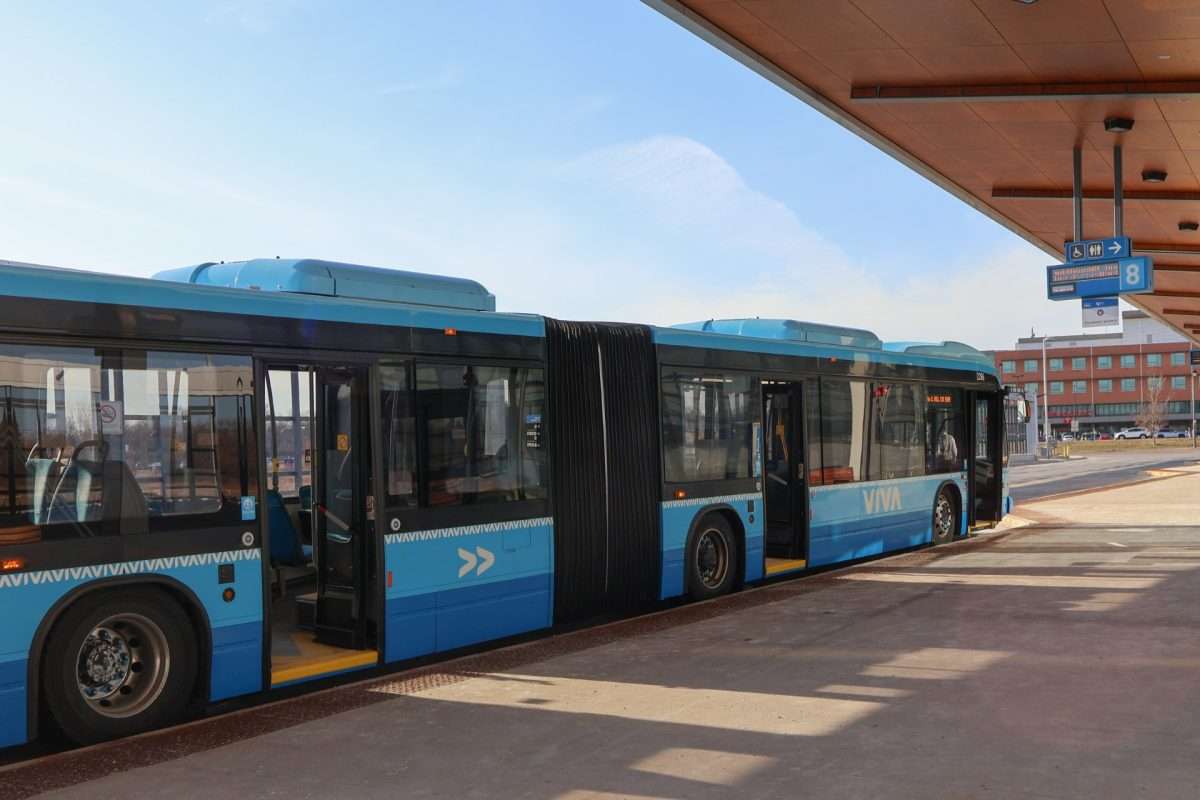
Photo: Yonge Corridor Secondary Plan developers considered how urban development would impact York Region Transit buses, along with other transportation modes. (David Yin photo)